

 Navigation
Combat
Готфрид "Гец" фон Криглихинген В молодости ставший героем войны и потерявший в бою руку, ныне Готфрид возглавляет один из ударных отрядов Кригмарка, что сами называют себя "Проклятыми".
Combat Rules
The clang of swords, the whisper of flying arrows, loud pops from the shots of aethereal muskets and the crackle of exploding reality of divine miracles all add up to the music of battle, which was and will be the best delight for the ears and eyes of the harsh gods of Torn, who stare at their children who have chosen their paths…
Every time a player declares an Action: Attack, both players must perform few steps to play him
Combat or Fight is the interaction of an Attacking Miniature and Miniatures that have become the target of an attack by rules described in this chapter.
Действие: Атака
Если на Плитке Действия присутствуют пиктограммы Ближнего Боя или
  Дистанционной
Атаки, то данное Действие считается Атакой.
Дистанционной
Атаки, то данное Действие считается Атакой.
Атакующая Miniature
Miniature, заявившая Действие: Атаку.
Защищающаяся Miniature
Miniature, ставшая целью Действия: Атаки.
The combat it's series of dice rolls made by both players. The owner of the Attacking Miniature receives all the necessary information about the Attack from the Action Tile of the selected Attack, and the player is the owner of the Defending Miniature from the Defence parameters of his Miniature, which became the target of the Attack.
The features and differences
of Melee Attacks and Ranged Attacks are described in the other sections of this chapter of the rules.
Action: An attack with the icon  "Ethereal" is considered an Ethereal Attack. Ethereal Attack does not have additional rules and abilities, but some rules and properties may refer to Ethereal Actions.

Structure Of Attack Action
Resolve Attack action takes place as a sequence of actions below:
1: Checking the legality of the target
The Player makes sure that the target of the Attack is within range and within visibility of the Attacking Miniature.
Range of Attacks are displayed with a special icon on the Action Tile. The target of the attack must be within this range.
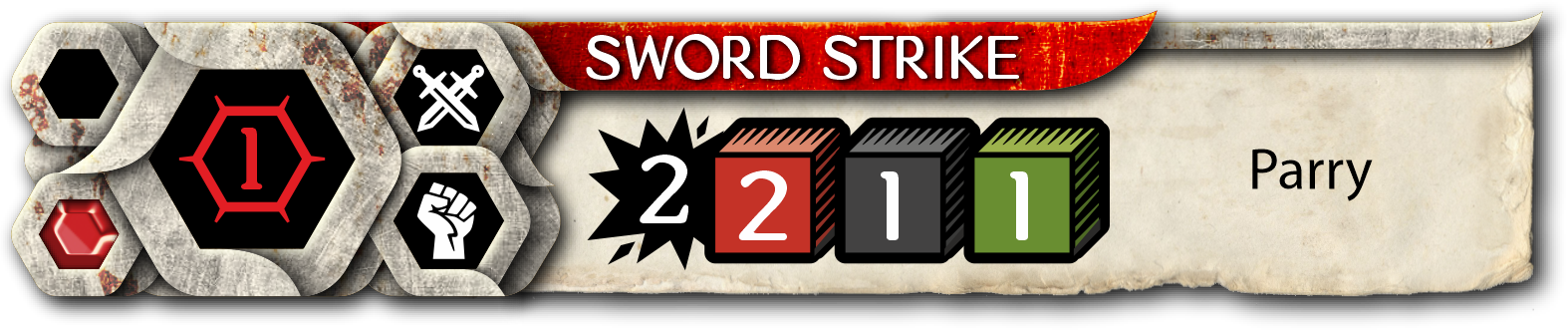
Sword Strike action has a range of one Hex. Target of attack can only be enemies in neighbouring Hexes
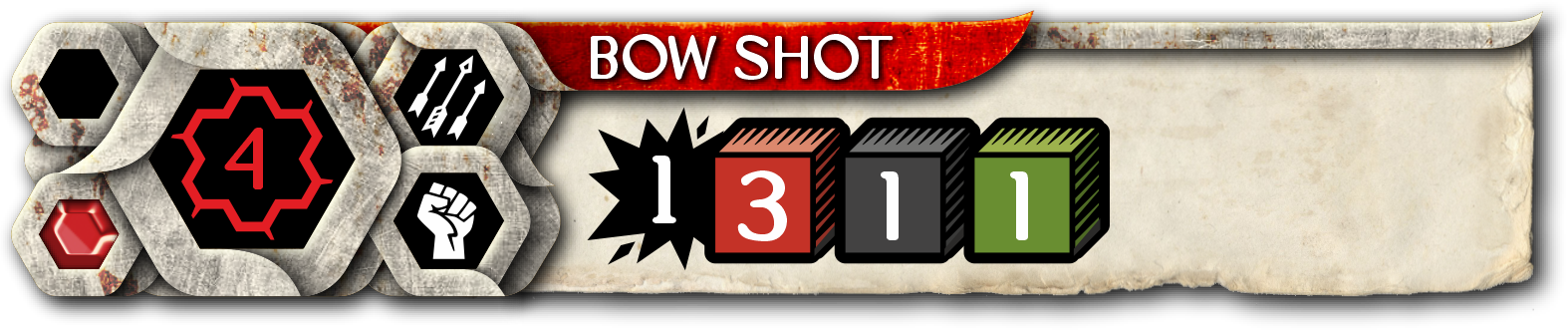
Action of Bowshot has a range of four Hexons. Target of the attack can be enemies within a distance of 4 Hexons from the Hexon in which the attacking Miniature is located.
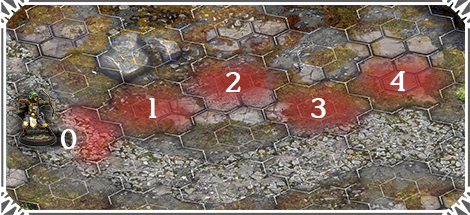
In addition to the fact that the Legal Target of the attack must be within the range of the selected Action, the target must also be within Sight of the attacking Miniature. Simply put, the attacker must see the target of his attack. Rules of visibility are described in detail in the chapter "Miniatures Visibility".
Important! The target of the Action: An attack with damage cannot be allied Miniatures. If the Attack Action has a Area Attack rule (or similar), it can also hit allies, but the enemy must be the chosen target for the Attack.
Легальная Цель
Miniature, которая находится в пределах Дистанции и в пределах Видимости.
2: Attack Roll
The player controlling the Attacking Miniature rolls a pool of dice indicated in the Action Tile.
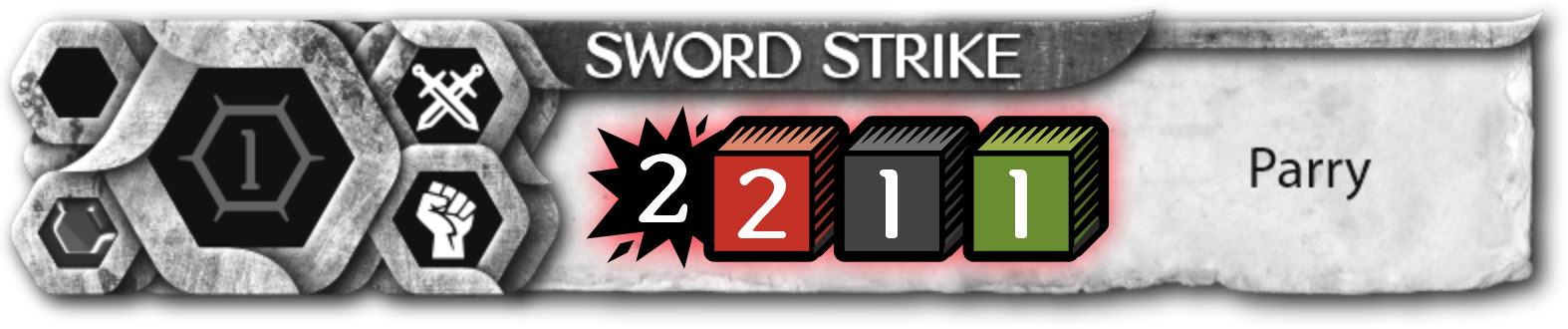
To perform the Sword Strike action, the player must make a roll of dice: two Attack Dice, a Skill Dice and a Agility Dice.
Example
Player Torgwar makes an Attack with his Rogue of Shadow Step and chooses the Dagger Strike Action to attack.
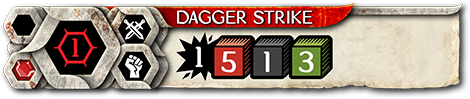
Torgwar rolls the nine dice indicated in the Action Tile.
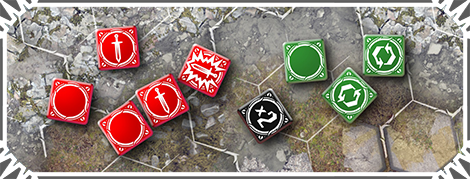
As a result, it gets: 


3: Agility
The player controlling the Attacking Miniature looks to see if there are Successful Agility Dice among the rolled values.
For each Successful Agility Dice, the player can rerolls one of the other dice (Attack
 or Skill
  ), that he rolled with him.
Some successful Dice can be used to reroll the same die.
Example
Of the three Dice of Agility roll Success fell on two Dice.
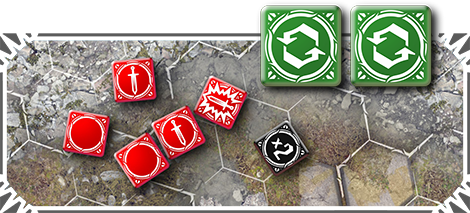
Torgwar decides to use two Successful Agility Dice to reroll two unsuccessful Attack Dice. Result of roll two Attack Dice turns out to be as follows:
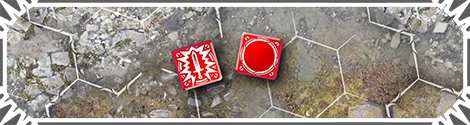
One more Critical Success is added to the pool of successful Dice..
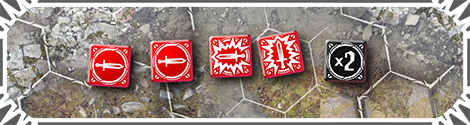
After that, the player removes all unsuccessful Dice and the final result of the Attack Dice Roll becomes:
4: Defense Roll
Player controlling the Defending Miniature rolls the pool of dice specified in the Miniature's Defense.
Number of dice required to Roll a Defense is displayed on the Miniatures Card inside the shield icon.
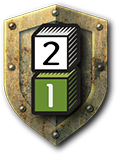
Example Of A Shield Icon. To make a Defense Roll, you must roll two Defense Dice and one Agility Dice.
Example
Noctis player makes a Defense Roll by rolling the dice indicated on the Miniatures Card.
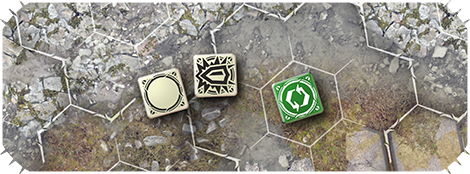
As a result of the roll, he gets the result: 

5: Agility
The player controlling the Defending Miniature looks to see if there are Successful Agility Dice among the rolled values.
For each Successful Agility Dice the player can reroll one of the Defense Dice  , that he rolled with him. Some successful Dice can be used to reroll the same die.
Example
Noctis decides to use a Successful Agility Dice to reroll an unsuccessful Defense Dice.
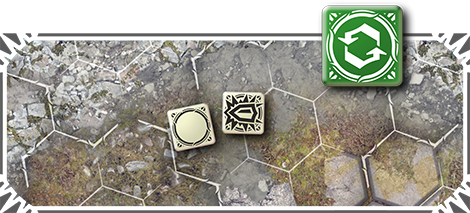
The result of the roll as follows:
Now the final result of the Defense Roll:
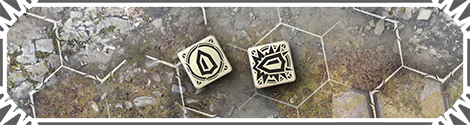
6: Comparing of rolls results
Comparing of successful Dice takes place in the following order:
1. Use of Defense Dice
The player controlling the Defending Miniature chooses which of the opponent's Attack Dice to apply his Defense Dice to.
Which of the successful Defence results can cancel out which of the successful Attack values will be show below.

Success on the Defense Dice cancels Success on the Attack Dice
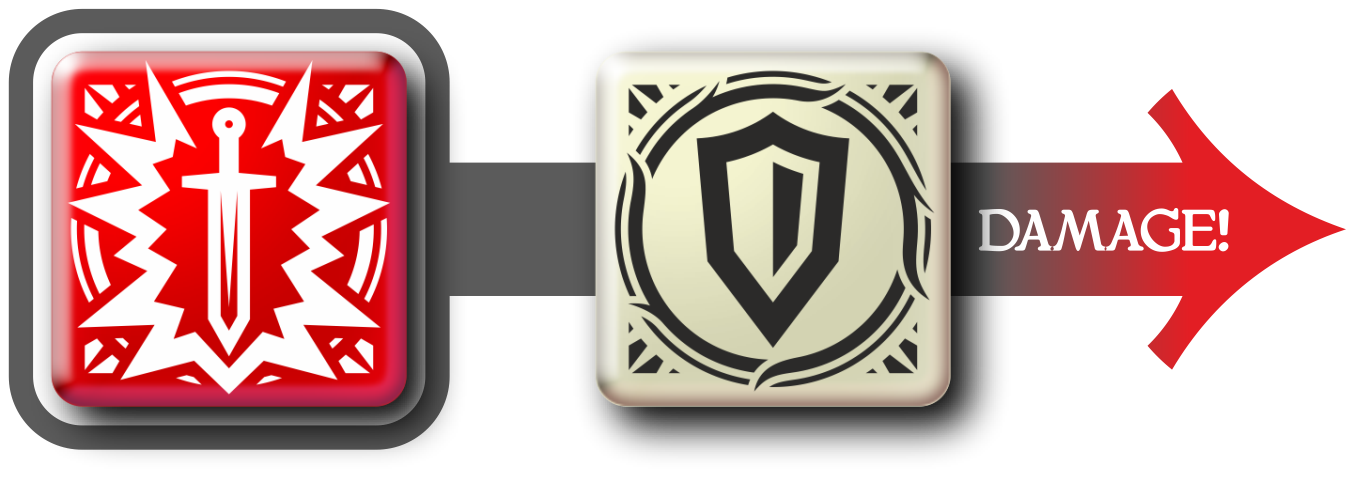
Success on the Defense Die does NOT cancels Critical Success on the Attack Dice. With a Success, it is not possible to cancel the Critical Success on the Attack Dice.
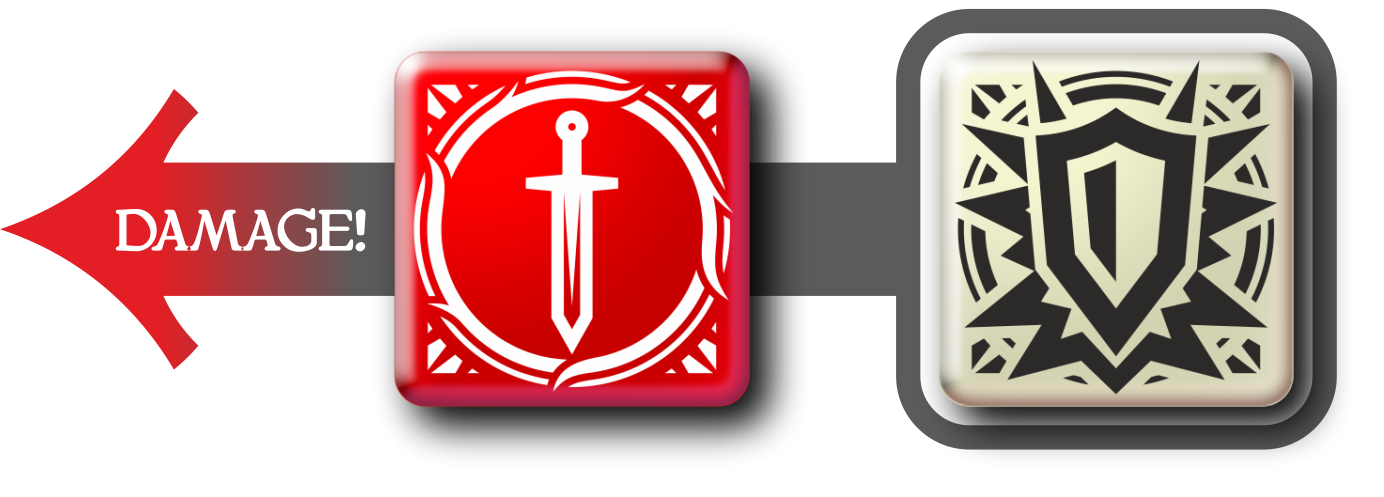
Critical Success can not only be used to cancel the Success on the Attack Dice, but also allows the Defending Miniature to deal damage to the Attacker according to the damage value of its Attack Action (even if it does not apply to the Attack Dice) if the Attacker is within the range of this Attack.

Critical Success on the Defense Dice cancels Critical Success on the Attack Dice.
Example
So, the Torgwar received the result of the Attack Roll:
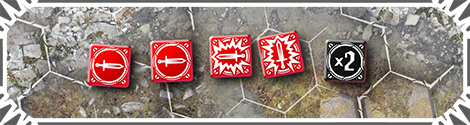
While Noctiis, having made a Defense Roll, received:
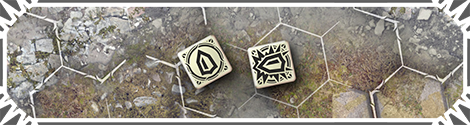
It's time for Noctis to make a choice on which of the Attack Dice to apply his Defense Dice to..
Success
can only cancel a normal Attack Success, so he applies it to one of them. With critical Success, you can cancel any Attack Dice, but canceling the usual one , you can inflict Damage to the attacker, which Noctis decides to use.
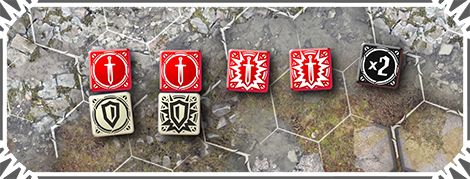
As a result, after applying the Defence Dice, Torgwar has following:
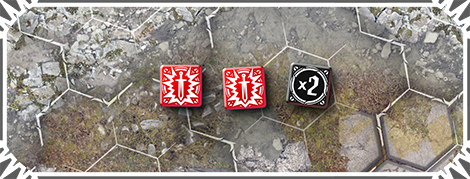
2. Using of Skill
After applying the Defense Dice, remove all canceled Attack Dice along with all Defense Dice, except Critical Successes , which should cause Damage..
After that, the player controlling the Attacking Miniature applies successful Skill Dice to his remaining Attack Dice, but no more than one Skill Dice to one Attack Dice. Dice to which the Skill Dice is applied is called the Skill Attack Dice.
7: Dealing Damage
At the last step of the Attack Action, damage is dealt.
For each remaining Attack Dice (Normal or Critical), the Defending Miniature loses the number of wounds equal to the Damage value indicated in the Action Tile of the used Attack.
For each remaining Skill Attack Dice (Normal or Critical), the Defending Miniature loses the number of wounds equal to twice the Damage value indicated in the Action Tile of the used Attack
For each remaining Critical Defense Dice, the Attacking Miniature loses the number of wounds, according to the Damage value of the Melee Attack Action of the Defending Miniature (if the attacker is within the range of this Attack Action)./p>
Players mark the damage received with Wound Markers. Miniatures that have reduced their number of wounds to zero (or lower) are removed from the battlefield as killed or severely wounded.
Example
Torgwar applies a Skill Dice to one of the remaining Attack Dice. Noctis choose a Defense Dice, which should deal damage.
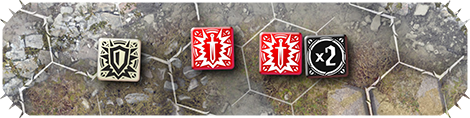
According to Action Tile, each remaining Attack Dice does 1 Damage, and Skill Attack Dice does double the value..
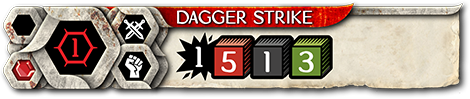
Total: Defending Miniature loses three wounds.
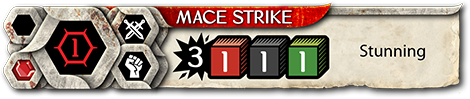
According to Action Tile of the Defending Miniature, the Critical Defense Dice deals three Damage to the Attacking Miniature.
Scheme of Attack
1: Checking Legality of the Target
Player controlling the Attacking Miniature makes sure that Target of the Attack is within range and within sight of Attacking Miniature.
2: Attack Roll
Player controlling the Attacking Miniature rolls a pool of dice indicated in the tile of the selected Action: Attacks.
3: Attacker's Agility/p>
Player controlling the Attacking Miniature uses Successful Agility Dice to reroll other dice with results that do not need him.
4: Defense Roll
Player controlling the Defending Miniature rolls the pool of dice specified in the Miniature's Defense.
5: Defender's Agility
Player controlling the Defending Miniature uses Successful Agility Dice to reroll other rolled dice with results that do not need him.
6: Comparing of roll results
Player controlling Defending Miniature chooses which of Attack Dice will be canceled by his Defense Dice. Players remove all cancelled Attack Dice and Defense dice (except Critical that cause damage). Attacking player applies successful Skill Dice.
7: Dealing Damage
Remaining Attack Dice deal damage to Defending Miniature. Remaining Critical Defense Dice deal damage to the Attacking Miniature. Both of these events are happening at the same time.

Type of Attack
Any Action: Attack belongs to one of two types: Melee Attack or Ranged Attack . Each of them has a number of features, which we will consider below.
Melee Attack
There are types of Melee Attacks with a range of more than one Hex. Usually Large Miniatures have an attack distance equal to one Hexon, and many long weapons have a range of more than one Hex.
If there are some enemies within the Melee Attack range, then only the enemies closest to the Attacking Miniature can become the target of the attack.
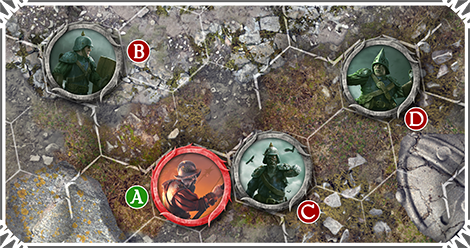
Halberdier Guardsman  has a Halberd attack distance of 3 Hex. Despite fact that the distance allows you to attack a Grenadier
  and a Line Soldier with a Mace
  , the closest enemy for him is the Returned.
  .
Only it can become the target of an Attack for a Halberdier from this position.
.
Only it can become the target of an Attack for a Halberdier from this position.
Ranged Attack
Ranged Attacks have a number of rules that difference them from Melee Attacks.
Critical Success on Ranged Attack Defense Dice does not dealt damage to attacker.
Miniature cannot perform Ranged Attack if there is an Enemy Miniature in the adjacent Hex.
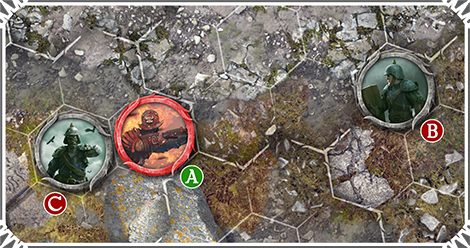
Musketeer Guardsman cannot make a Ranged Attack on a Line Soldier with a Mace , because there is an enemy Miniature of the Returned in the Hex next to him. . He must move away from the enemy, or make a Melee Attack on him.
Miniatures Visibility
One of important conditions for making an Attack is to find target of Attack within sight of the Attacker. Most often, it is necessary to check the visibility of the target when making a Ranged Attack.
By default, any enemy is within sight of the Attacker. But there are a some game situations in which the Miniature is out of sight:
• Miniature Property
• Effect of the Card of Gods
• Target is in Cover
Cover
One of the situations when the target of an attack is out of sight is to gain an advantage from the Elements of the Landscape, which is called "Cover". Miniature that has received Cover from an attacker disappears from view for the attacker and usually cannot become the target of its attack.
Укрытие
Состояние, при котором враг не видит Миниатюру, находящуюся в Укрытии.
Closing Landscape
Miniatures can only get Cover by interacting with Landscape Elements that provide Cover (they are also called a Closing Landscape). Most common types of Closing Landscape are: Volume Landscape and Ethereal Vortices.
Low Visibility Zone
When you make a Ranged Attack on a miniature in a Low-Visibility Zone, reroll all successful rolls of attack dice (after applying agility dice)
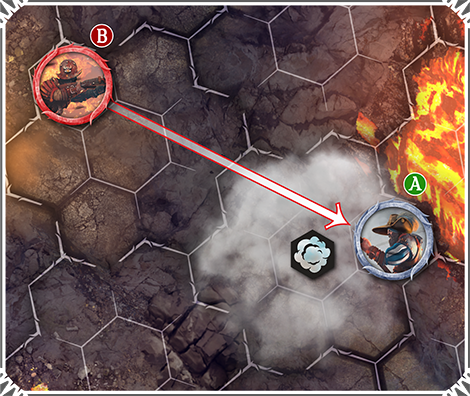
Example: A miniature of the Musketeer of Castila makes a ranged attack on a Miniature of the Guerrillas of the Priory of Hope, which is located in the same hexon with a Smoke charge marker. Since a hexon with such a marker is a Low Visibility Zone, the Musketeer will reroll all successful rolls of attack dice after applying the result of his Agility Dice.
Hexon Line
One of the important steps in determining the Cover is to make Hexon Lines from the Miniature. A line of Hexons is a series of neighbouring hexons that make up a straight line.
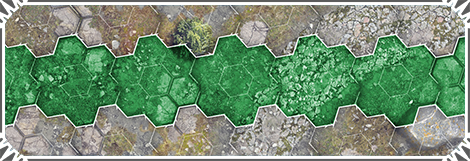
Example of a Hexon Line of a number of neighbouring Hexons forming a straight line.
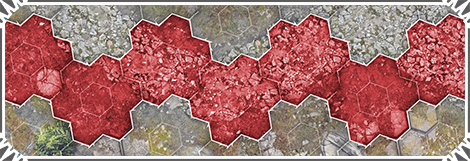
This sequence of Hexons is not considered a Hexon Line. They don't form a straight line.
Cover for Infantry Miniatures
To determine whether an Infantry Miniature is in Cover, you need to go through the following steps and make sure that the game situation meets the conditions described below:
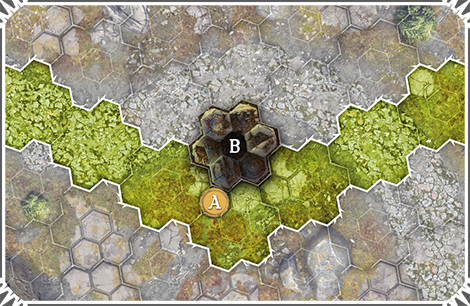
Miniature should be located in an adjacent Hex from the Closing Landscape.
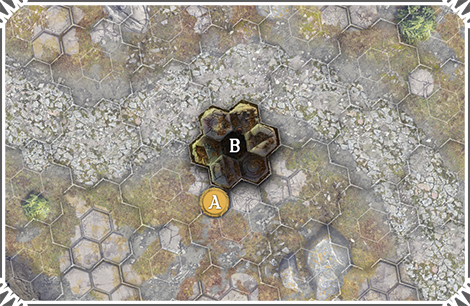
Miniature A is located in an neighbouring Hex from the Closing Landscape B.
Make two imaginary Lines of Hexons from the Hexon that the Miniature takes. The lines should also touch the Landscape.
Lines of Hexons from the Miniature hiding behind the Landscape are marked in green.
All Hexons that are located inside the zone bounded by two Lines of Hexons are considered a "Blind Zone". All Miniatures in these Hexons do not see the Miniature and conversely.
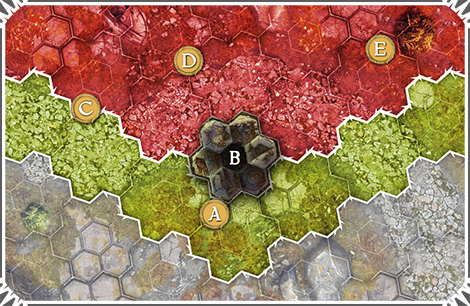
The "Blind Zone" is marked in red. Miniatures C, D and E do not see miniature A.
All Hexons that are not included in the "Blind Zone" are areas of open visibility. All Miniatures take Hexons outside the "Blind Zone" see the Miniature and conversely.
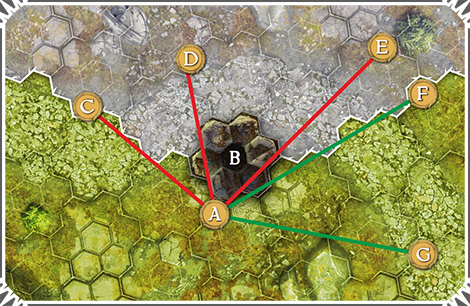
Miniatures taking Hexons and marked in green (miniatures F and H), see miniature A. A. She, in turn, sees them.
Miniatures C, D and E are in the "Blind Zone" for Miniature A and do not see it. This miniature doesn't see them;
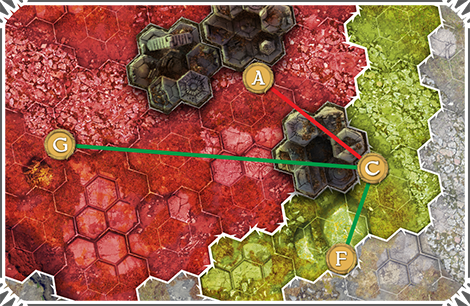
Example 1
Miniature Atakes a Hex neighbouring to the Closing Landscape. Who sees her?
Miniatures D and E do not see А, because they are in her "Blind Zone".
Miniature B seesА, being on the Line of Hexons with А.
Miniatures F and H are visibleА, outside the "Blind Zone".
Miniature В does not see Miniature А, because it takes an neighbouring Hex with the Closing Landscape, as a result of which miniature А A does not see and conversely.
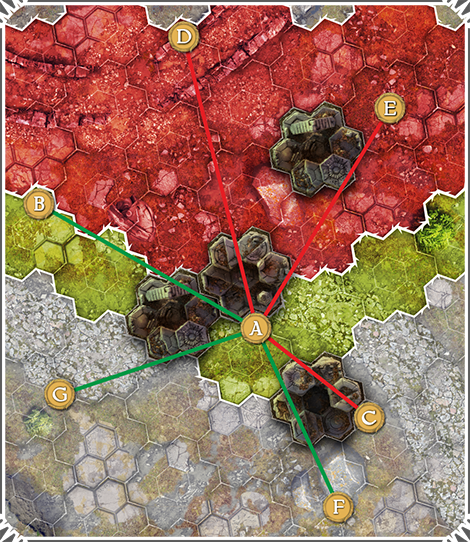
Important! If the Miniature takes a Hex neighbouring to two Elements of the Closing Landscape, then their "Blind Zone" are combined into one. To simplify the definition of their common "Blind Zone", make one imaginary Line of Hexons that touches both Closing Landscapes.
Example 2
Miniature A takes a Hex adjacent to two Elements of the Closing Landscape. Who sees it?
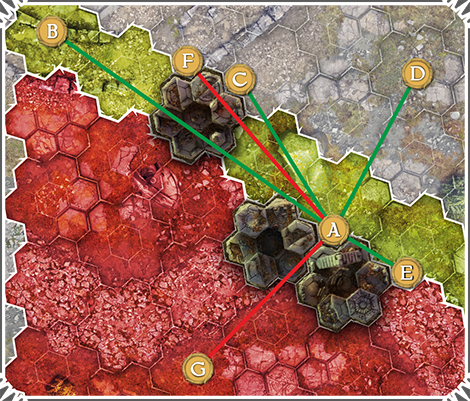
Miniature B sees А, being on the same Hexon Line.
Miniature C in sees А. Although it takes an adjacent hex to the Closing Landscape, Miniature А is not in its Blind Zone
Miniatures E and Dsee miniature А.
Miniature F is on the same Line of Hexons with А, but it does not see А. Miniature А is located in its "Blind Zone".
Miniature H does not see А, because it is in its "Blind Zone".
Cover for Large Miniatures
To determine if a Large Miniature is in Cover, you need to go through the following steps and make sure that the game situation meets the conditions described below:
Miniature should be located in an neighbouring Hexon from the Closing Landscape.
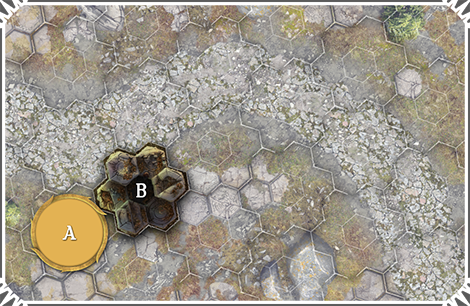
Miniature А is located in an neighbouring Hexon from the Closing Landscape B.
Make an imaginary Line of Hexons from the Hexon that the Miniature takes to the Hexon with the Closing Landscape and beyond.
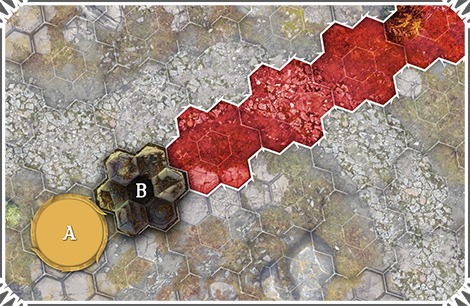
Line of Hexons is marked in red from the one occupied by the Miniature to the Closing Landscape and beyond.
All Hexons that are on this Hexon Line are considered a "Blind Zone". Everyone in these Hexons does not see this miniatures.
All Hexons that are not included in the "Blind Zone" are areas of open visibility. All Miniatures that are not in the "Blind Zone" see this Miniature.
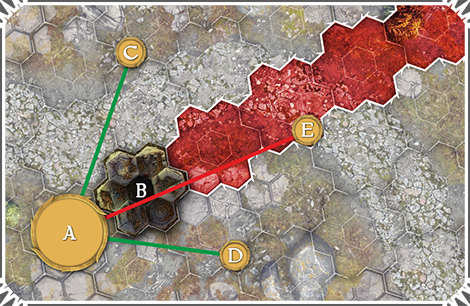
"Blind Zone" is marked in red. Miniature E not see Miniature А and conversely. Miniatures C and D see Miniature А.
Cover for Huge Miniatures
Huge Miniatures do not get Cover from the Landscape Elements and all other Miniatures on the battlefield see them regardless of whether they are hidden by the Landscape or not..
Often, Huge Miniatures themselves tend to give Cover to other Miniatures on the battlefield, like a Closing Landscape.
Advantage Of Large Miniatures
Though Large Miniatures have less chance of getting Cover, they can get +1 Defence Dice to the Defence Roll when they are in an adjacent Hex from the Closing Landscape. This rule is called Taking advantage of ranged attacks
Miniature should be located in an adjacent Hexon from the Closing Landscape.
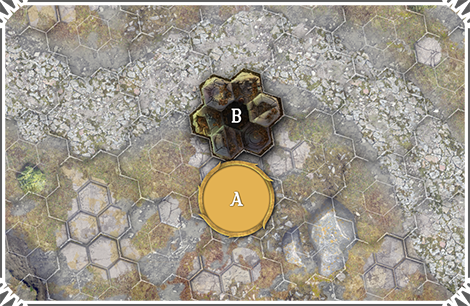
Miniature А is located in an adjacent Hexon from the Closing Landscape B.
They should touch the Landscape.
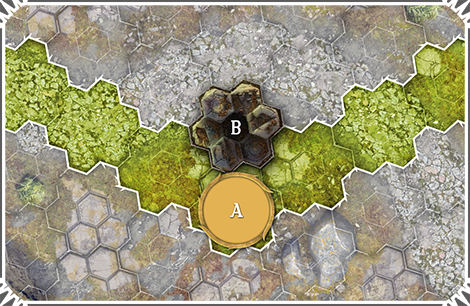
Lines of Hexons from the Miniature hiding behind the Landscape are marked in green.
All Hexons that are located inside the zone bounded by two Lines of Hexons are considered a "Defence Zone". A large Miniature get +1 Defence Dice to the Defence Roll from attacks of any Miniatures located in the Hexons of the "Defence Zone".
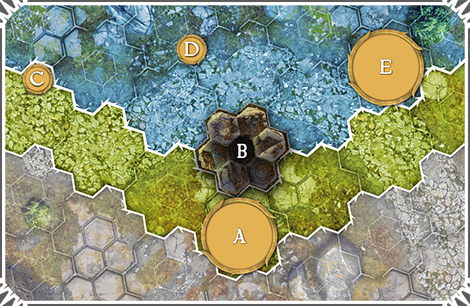
"Defence Zone" is marked in blue. А Miniature A gets +1 Defence Dice to Defence Roll from attacks of Miniatures D and E. Miniature А does not benefit from attacks from Miniature C, because it is outside the "Defensive Zone".
Upon receiving the "Advantage", the Miniature get no more than + 1 Defence Dice, regardless of how many Closing elements of the Landscape are located in Hexons adjacent to the miniature.
Attack on a Group of Miniatures
If the target of a Ranged Attack becomes a Miniature, in neighbouring Hexes from which there are other Miniatures (which are within Range and Visibility), then after "Step 3: Using Agility" and applying all Agility Dice, all unsuccessful dice, including Attack, Skill and Agility Dice, are roll again to make an Attack on the one closest to the Attacker Miniature (regardless of whether it is an Ally or an Enemy). Miniature that became the target of this Attack also makes Defense Dice Rolls and goes through all the same steps as with a normal Attack.
If, in the situation described above, several Miniatures in adjacent Hexes from the target of a Ranged Attack are at the same distance from the Attacker, then the player controlling the Attacking Miniature chooses who will become the target of the Attack in case of unsuccessful dice when making Attack Rolls.
After making an attack on a Miniature adjacent to the original target of the attack, the rule of "Ranged Attack into a Group of Miniatures" does not apply to the following possible targets.
Example
Musketeer of Castila
makes a Ranged Attack, targeting a Line Solider with a Mace . After making dice rolls to determine success of the Attack, all unsuccessful dice are roll again, choosing the nearest Miniature in neighbouring Hex from the target of the Attack as the target of the Attack.
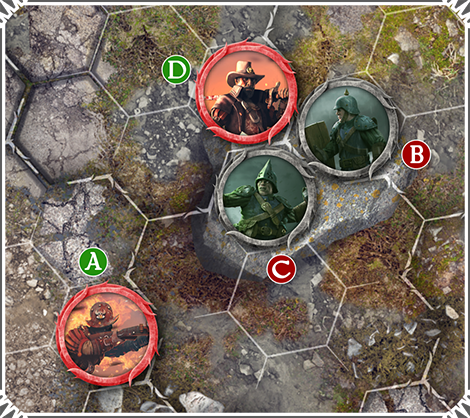
There are two Miniatures in neighbouring Hexes from the target of the attack: The Doomed Grenadie and the Hunter of Saints  . Doomed Grenadier is closer to the Attacking Miniature and it is he who will become the target of the unsuccessful dice being roll.
Engage Miniatures
If there is an enemy in the Hex nearby to the Miniature, then the miniature is "Engaged".
Every time Engaged Miniature declares any action other than Attack or Concentration, it can become the target of a Free Attack from all enemy Miniatures that are within one Hex of it.
Free Attack
Free Attack it's Melee Attack action, the target of which is a Miniature that triggered a Free Attack.
If Miniature has more than one type of Melee Attack action, then the player controlling the Miniature chooses which of them will make a Free Attack.
Making a Free Attack does not use Miniature Activation. This means that after making a Free Attack, it can be Activated (if it has not yet been activated during this Turn). Activated Miniatures can also make Free Attacks.
Miniature can declare any number of Free Attacks during a Turn.
Miniature cannot declare more than one Free Attack during a single Activation of an enemy Miniature, even if the enemy triggers a Free Attack more than once.
If Miniature is Engaged by several enemies, then it receives Free Attacks from each of them.
Important! Critical successes on Defense Rolls from Free Attacks do not cause damage to the attacker.
A Free Attack can only be made by Melee Attack Action. If the Miniature has no one Action, it cannot make Free Attacks.
If the Melee Attack Action has the Area Attack property or any similar property that can select more than one target to attack, only the Miniature that triggers it becomes the target of the Free Attack.
Free Attack is played immediately after declare of the Action that triggered Free Attack. After that, the player plays the declared Action, if at that moment the Miniature is still on the battlefield.
Miniature that has a Condition Marker or is located on an Ethereal Vortex or a Dangerous Landscape does not make Free Attacks.
Attack without Damage
In addition to the normal attacks that deal damage to the enemy, there are special attacks that do no damage. Their goal is to manipulate the enemy on the battlefield. Actions: Attacks without Damage on the action tile have a number of features that distinguish them from usual attacks:
If there is no image of Dice on the Action: Attack Tile, then it is always considered successful after the declare. Players play effect described in Action Tile.
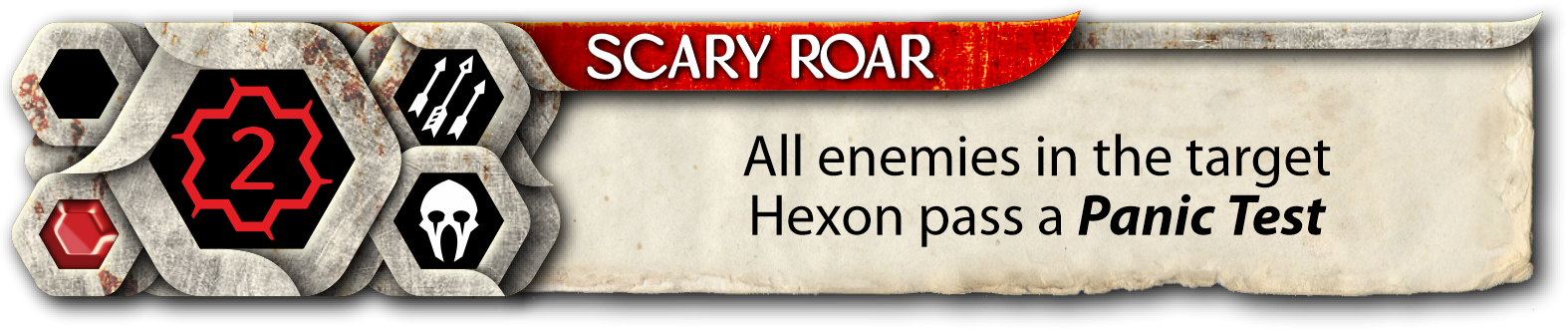
By declaring the Scary Roar Action, the player controlling the attacking Miniature does not make dice rolls. By choosing a Hexon within range and visibility, he makes all enemies in it to pass a Panic Test.
If there are images of Dice on the Action: Attack Tile, then the effect described on the Tile is triggered only when at least one success is achieved on the Attack Dice (including Critical Success).
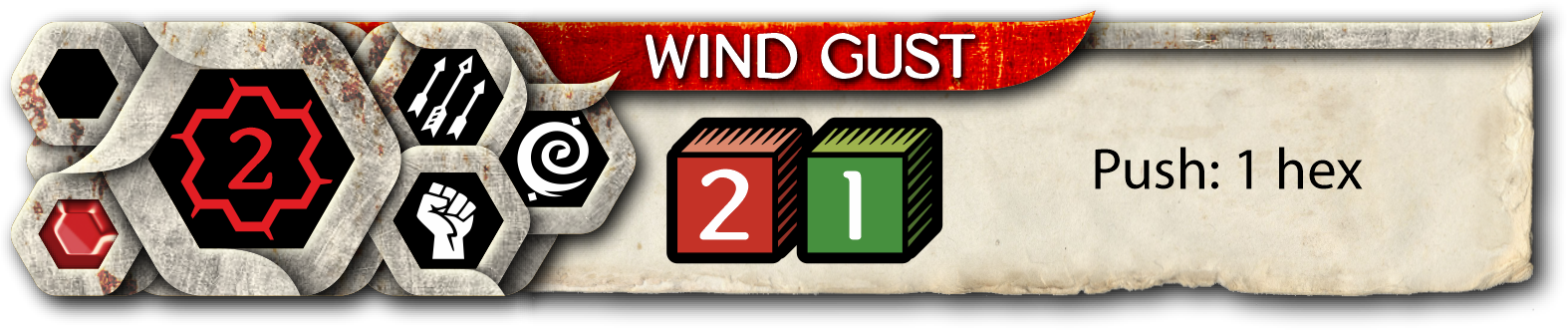
After declaring a Wind Gust action, player controlling attacking Miniatures rolls the indicated dice. If there is at least one Successful Attack Cube on result of the roll, attack target must be shifted. The enemy may still take an Dexterity Test to choose a Hex to shift.
Important! A miniature that has become the target of an Attack without damage never makes a Defense Roll.
Miniatures that are Immune to the "Type of Damage" which has Action ignore its effects
Evade
At the player's request or in some game situations, a Defense Roll can only be made with the Agility Dice indicated in the Miniature's Defense on its card..
In this case, the Miniature is considered to Evade by Attack.
Бросок Защиты
Кубики, которые необходимо бросить игроку для определения результата защиты Miniatures от проводимой по ней атаки.
When the Miniature declares Evade, the player rolls all Agility Dice  that are in the shield icon on her card.
Each Success on the Agility Dice is considered a successful Evade and cancels one
Successful (non-critical) Attack Dice.

Success on the Agility Dice cancels Success on the Attack Dice.
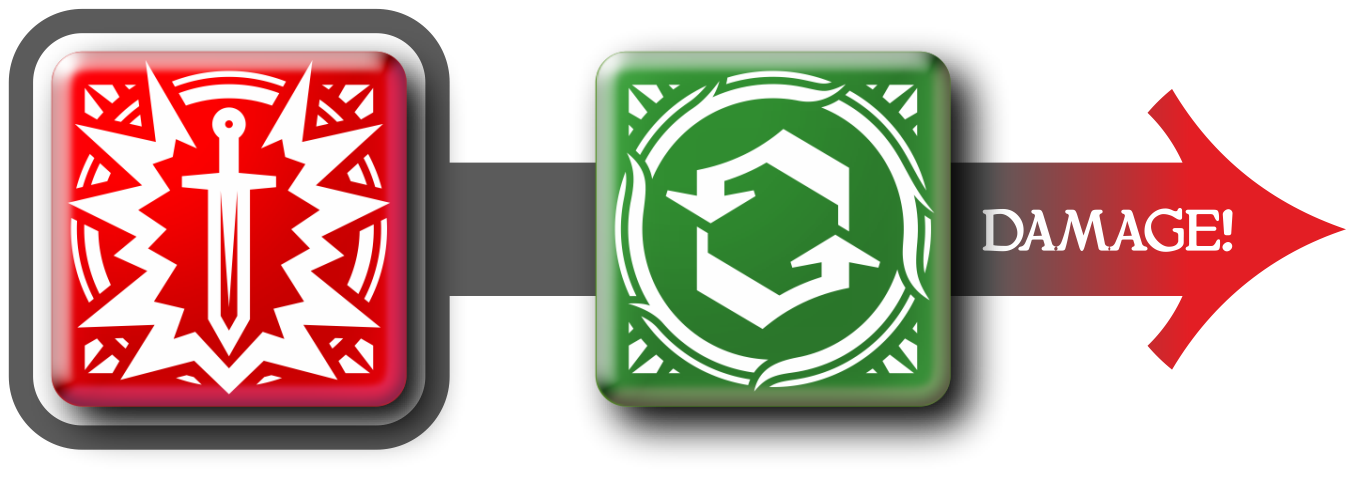
Success on the Agility Dice does NOT cancel Critical Success on the Attack Dice.
Crushing Damage
Some attacks are so devastating that the defender can't to defend against them with his armor and protective equipment. In this case, he can only evade the attack.
If the Damage value on the attacker's Action Tile is equal to or higher than the value of the maximum number of Wounds of the defender, then you can only defend against such an attack by Evade.
Example
The Faceless One makes an attack by choosing a Sword Strike with a damage value of five. The value of the maximum number of wounds of Engel's Swordsman who is the target of an attack is five, and he can only use Evade.
Type of Damage
Each Action: Attack has an icon with the type of damage it deals. Each Action: Attack has an icon with the type of damage it deals
There are the following Types of damage:

Physical damage

Fire Damage

Cold damage/p>

Electrical damage

Poisoned Damage

Mental damage
Vulnerability and Protection
Some Miniatures have the properties of "Vulnerability" or "Protection" from one or another type of damage. Some Miniatures have the properties of "Vulnerability" or "Protection" from one or another type of damage.
Damage immunity
Miniatures that are "Immune to the type of damage" do not receive damage, markers and effects from any sources that belong to this type of damage
Damage with effect
Some attacks have the ability to apply State Markers to target of attack. Presence of this property is indicated on the Actions tile by an icon or inscription.

When dealing Critical Damage  , the target gets "Burning".

ПWhen dealing Critical Damage  , the target gets "Slowed".

When dealing Critical Damage.  , the target gets "Poisoned".

When dealing Critical Damage  , the target is "Stunned".

When dealing Critical Damage  , the target gets "Bleeding".

When dealing Critical Damage  , the target get a "Panic".
"Damage with Effect" is triggered only when taking damage from a Critical Attack Dice..When taking damage from a Critical Defence Dice ,
the Condition Marker is not applied.
Important! A miniature cannot receive more than one Marker of the same Condition. If the Miniature should get a Condition Marker that it already has, then the Marker is not applied.
Counter Attack
When the miniature declare Melee Attack that targets one or more Miniatures that have not yet been Activated, then any number of defending non-activated Miniatures can declare a Counter Attack, the target of which will be the attacking miniature.
Counter Attack is an Action: A Reaction that can be declared by a Miniature with an Action: A Melee Attack or a Ranged Attack с with the Assault rule.
Reaction: Counter Attack is declared upon the occurrence of "Step 6: Declare Reactions" during the Activation of the attacking Miniature.
The defending Miniature, which has declared a Counter Attack, must choose the Action Атака Melee Attack or Ranged Attack with the "Assault" rule, which will make a Counter Attack.
Counter Attack is played out as follows: both Miniatures - Attacking and Defending - attack each other, by common rules.
Players can play Attacks one at a time, but apply the results of all Attacks as if they were make in the same time. As a result of a Counter Attack, both the attacking and defending Miniatures can be killed by each other.
Ethereal Attack
Action: Attack that has a special icon on its Action Tile - , is considered an Ethereal Attack. This type of Attack has no special rules and is necessary to interact with properties and rules that refer to Ethereal Attacks, Ethereal Effects or Ethereal sources of damage./p>
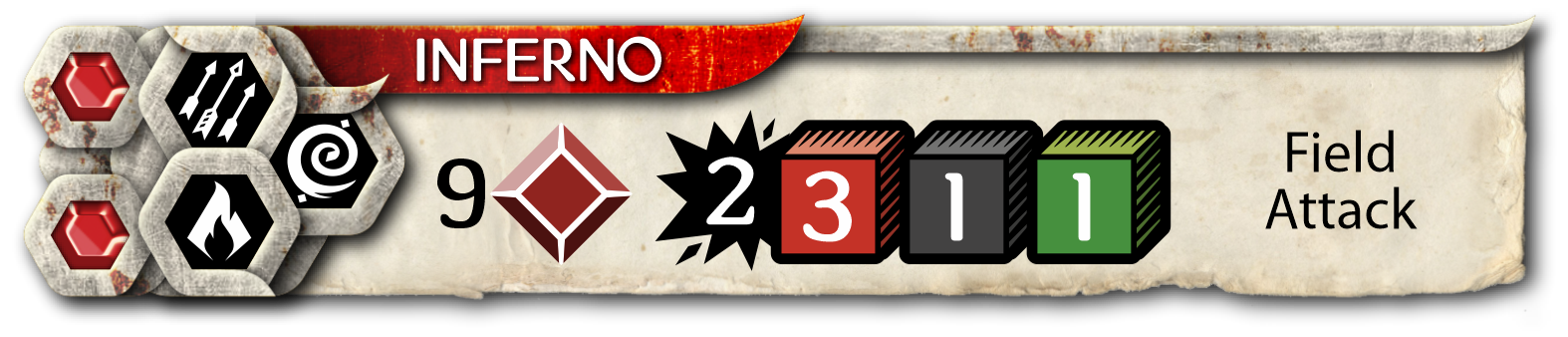
"Inferno" is one example of an Ethereal Attack. For example, Miniatures with "Ether Protection" will receive additional Defence Dice from this attack.
Morale
There are situations when a Miniature needs to pass a Panic Test to determine whether it is ready to fight on or will falter and retreat during its Activation.
Тест на Панику
Проверка, совершаемая броском Кубика Защиты .
При выпадении Успеха или Критического Успеха, проверка считается успешной.
В противном случае Miniature получает маркер "Паника" .
By default, the Miniature rolls one Defence Die when passing the Panic Test, but some abilities may allow you to increase or decrease the number of Dice roll.
Ability: Veteran.
Miniature rolls two Defence Dice when passing Panic Test.
Ability: Careful.
Miniature automatically fails any Panic Tests.
Miniatures with "Immunity to Mental Sources" cannot receive "Panic" markers and always pass Panic Tests without rolling Dice.
Loss of Expedition Leader
The leader of the Expedition is the main figure of the player. This is a character who has gathered under his banners those who are ready to go with him to the very end. That is why, if the Leader of Expedition dies, it has a hard effect on the morale of the entire squad.
If the Leader of the player's Expedition is removed from the battlefield at a loss, then all the player's Miniatures must pass the Panic Test. Passing the Panic Test resolve immediately after the moment when the Leader of the Squad was killed.
If the Leader's Miniature has the ability to transform when the last unit of wound is lost, then at the moment of death (followed by transformation), the player's Miniatures do not pass the Panic Test.
If the transformation comes from an outside source (the ability of another Miniature or God Card), then the player's Miniatures must pass the Panic Test.