

 Navigation
Game Elements
Equipment for the Expedition
In order to immerse yourself in a world of harsh battles, create your Expeditionary Squad and set out to explore the heart of the Epicentres of the Ether you will need a some of important elements. Later in this chapter we will look at them in more detail. Let's see if you have what you need for the game!
Miniatures
Game Dices
Cards of Ether Wonders
Cards of Gods
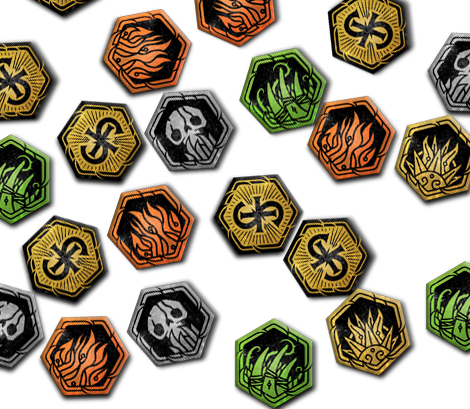
Scenario Markers
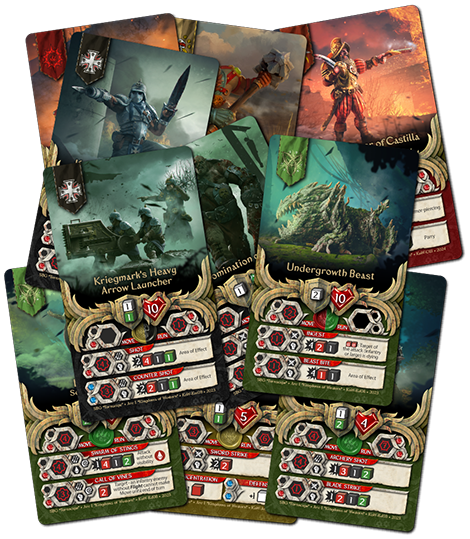
Cards of Miniatures
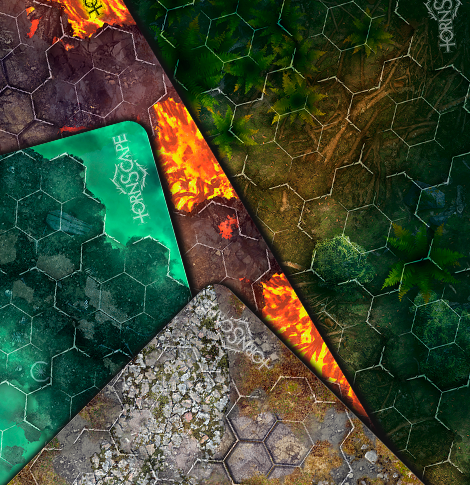
Battlefield
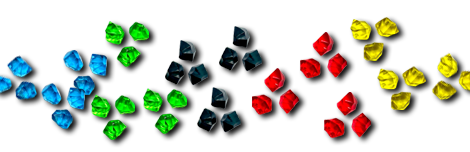
Crystal Tokens
Landscape
Miniatures
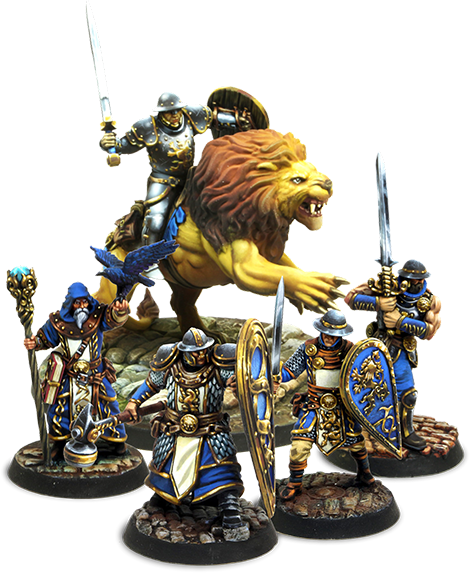
Heroes and soldiers, monsters and divine creatures - they are all reflected in the Miniatures During the game you will have to take control of an Expedition Squad of Miniatures, which will be led by the chosen Hero.
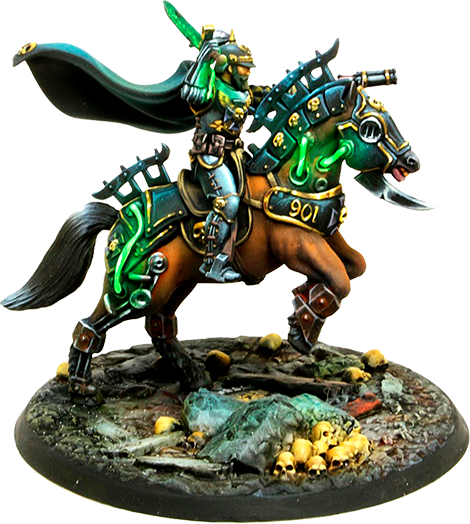
Gottfried "Getz" von Krieglichingen is one of the heroes of the Kriegmark faction
On the battlefield the Miniature of the Hero represents the player who leads his Expedition Squad into battle
All the abilities and parameters of the Miniature are placed on a special Miniatures Card.
Types of Miniatures
An Infantry Miniature.
It is stand on a base with a diameter of 32mm. The Infantry Miniature takes 1 Hex on the battlefield.
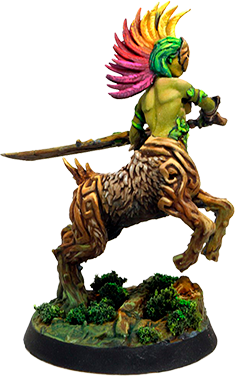
Dryadint Centaur an example of an Infantry Miniature.
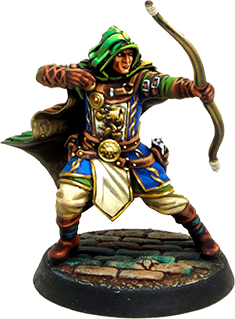
Engeln's Ranger an example of an Infantry Miniature.

Hex is a hexagonal cell in the layout of the battlefield. Large Miniature
Large Miniature.
It is stand on a base with a diameter of 80mm. Large Miniature takes 1 Hexon on the battlefield.
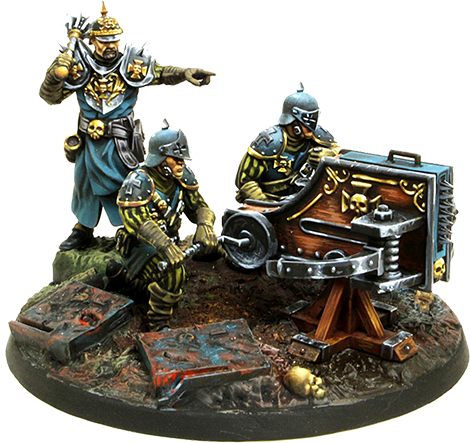
Kriegmark's Heavy Arrow Launcher an example of A Large Miniature.

A Hexon is a figure composed of seven Hexes. Its outline is shown on the battlefield markings
Huge Miniature
Takes two or more Hexons on the BattleField.
Allies and Enemies
During the game rules or abilities may refer to Miniatures on the battlefield, meaning Miniatures controlled by one or a second player For clarity the game has the concepts of an Allied Miniature (or Ally) and an Enemy Miniature (or Enemy).
Summary
Three Sizes of Miniatures:
Infantry - takes 1 Hex.
Large takes - 1 Hexon.
Huge - they takes more than 1 Hexon.
The ally - miniature is under your control
The enemy - miniature under the control of the Opponent.
Card of Miniatures
Each Miniature has a number of abilities and parameters that are fully reflected on its Card. All abilities and actions of the Miniature are placed on its card.
If you have some miniatures of the same type in your Squad, you can use one card for them miniatures
Let's see what elements are on the miniature card
The front side of the Card
1 - Flag
The banner of the faction of miniature.
2 - Illustration
A unique image that helps determine whether a card belongs to a miniature
3 - Name
A unique name that associates a miniature with a set of its rules.
4 - Defense
The number of Defense Dices and Agility Dices that the player rolls when use Defense or Evade.
5 - Wounds
The maximum number of Miniature wounds.
6 - Movement
The maximum distance to move the miniature when performing the "Move" or "Run" action.
7 - Devotion
A parameter indicating which of the Faith Markers the player can receive from the Miniature at the moment of "Receiving Faith".
8 - Action Tiles
Usually the list continues on the back of the Card.
The back side of the Card
1 - Illustration
A unique image that helps determine whether a card belongs to a miniature.
2 - Wounds
The maximum number of Miniature wounds.
3 - Defense
The number of Defense Dices and Agility Dices that the player rolls when use Defense or Evade.
4 - Action Tiles
Usually the list continues on the back of the Card.
5 - Properties
Special rules and abilities that the Miniature has.
6 - Keywords
A set of words containing a race, faction, type, and weapon that can be referenced by rules and characteristics.
The Great Origin Ones who created the beautiful face of Torn are looking at all of us in impatience! You are the light of Torn! The light of Castilla! But I ask you, if the light loses its power and goes out, is it possible to light it again? No, it will no longer be suitable for anything, just to tear it out of the face of the earth and burn it in a cleansing flame!.."
An excerpt from a sermon by Tolero Herred II.
Battlefield
The battlefield is a covering representing a one of location of the Torn. It's limits the playing space and has a special marking grid of Hexes and Hexons, which is used to measure distances and position Miniatures.
Гекс
Шестиугольная ячейка на Игровом Поле. Гекс является минимальной единицей измерения и его размер кратен подставке Пехотной Миниатюры.
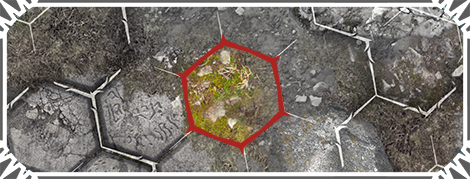
The highlighted cell in the image is a Hex.
Hexes
Let's look below at what Hexes are used for on the battlefield.
Hexes contain one Infantry Miniature on the battlefield. No more than one miniatures can be placed on one Hex. Infantry miniatures have bases with a diameter of 32 mm, which are equals of one Hex.
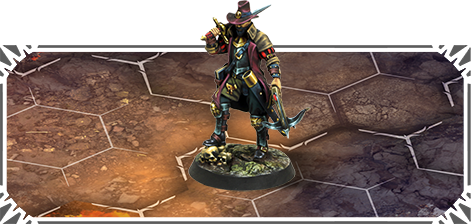
The miniature of the Saint's Hunter of always takes one Hex.
Hexes allow you to measure the distance for moving Infantry Miniatures
Example
The player Torgvar decided to make a move with his Engel Swordman
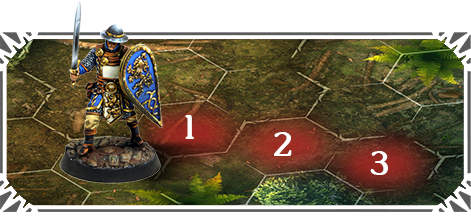
The Move action distance is equal to 3 Hexes.
The Torgvar moves his Miniature three Hexes in the selected direction.
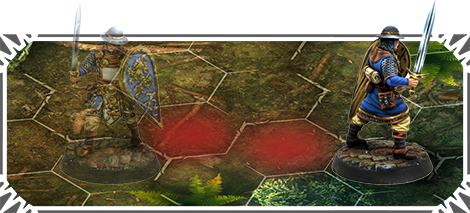
Hexes define range for Melee weapon Attacks (for Infantry Miniatures) and other Actions that have a Hexes dimension (for example, to Explore or Take an Object).
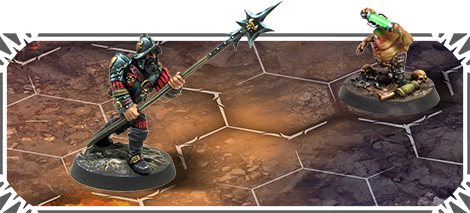
For Castilla Guardsman range of a Halberd Strike is 3 Hexes, and he can attack a Homunculus despite the fact that they are separated by 2 Hexes.
Hexons
Гексон
Группа из семи смежных Гексов, ограниченная на Игровом Поле специальной разметкой. Гексон является максимальной единицей измерения на Игровом Поле и его размер кратен подставке Большой Миниатюры.
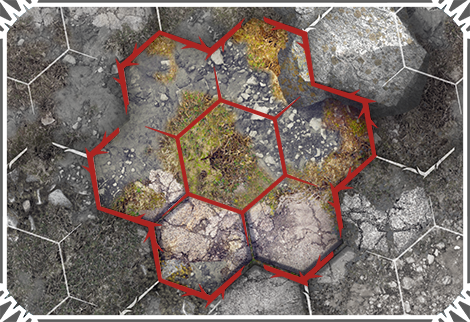
Highlighted group of seven Hexes in the image is Hexon.
Let's see below what Hexons are used for on the battlefield.
Hexons position one Large Miniature on battlefield. No more than one Large Miniature may be positioned on a single Hexon. Large Miniatures have 80mm diameter bases, divisible by one Hexon.
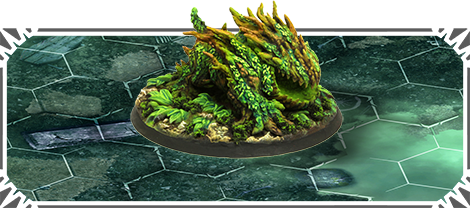
The Undergrowth beast takes one Hexon.
Hexons allow you to measure the distance to move Large Miniatures
Hexons determine range for Melee Attacks. Most Large Miniatures have a Melee Attack range equal to 1 Hexon adjacent to the Miniature.
Hexons determine range for Ranged Attacks.
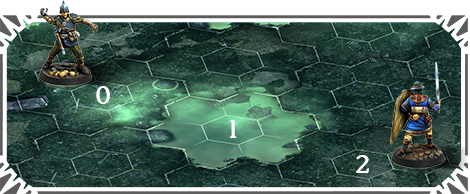
The range of a Ranged Attack for a Doomed Grenadier is 2 Hexons. Engel's Swordsman is within this range and can be the target of his Ranged Attack. It's counting down from the Hexon that the Miniature occupies.
Game Dices
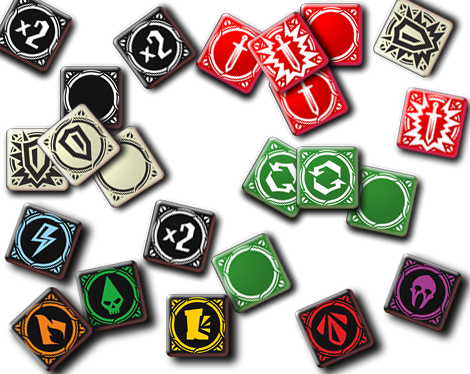
During the game, players will often need to determine the success/ failure of an action or effect by rolling special dice, which is also called "Torn Dice". There are four types of Torn Dice and each of them has its own color and use.
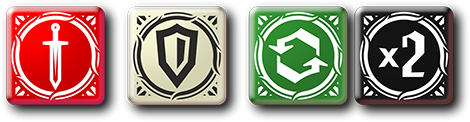
Torn Dice are: Attack Dice (red), Defense Dice (white), Agility Dice (green) and Skill Dice (black).
Often, game rules require to roll more than one dice to determine the result of an effect or action. A set of dice that a player needs to roll is called a Dice Pool. For convenience and acceleration of the gameplay, all the necessary dice are rolled at the same time.
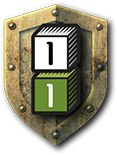
One example of a property requiring a Dice Pool roll is "Miniature Defense". In this example, you need to roll two Dice.
The Great Forest
"Going in the opposite direction following the footsteps of the first trees, the ranger squad met another group of Trees much larger in quantity and surrounded by forest dwellers. Humanlike creatures with olive skin and wierd clothes were scattered around the Mother Trees, someone was picking fruits and berries from the surrounding plants, someone was sitting on the branches of slowly wandering trees. They looked quite peaceful, and that's what killed the small group of scouts. Just as Erling was about to signal for a reposition, a massive beast crashed down from the tree branches right into the center of their position, knocking one of the scouts to the ground with a single powerful swipe of its paw. Another fighter quickly turned around and shot an arrow point-blank at the monster, but it only trembled, piercing his skin as if hitting a thick board. A strange creature that had just been a tree stretched out its flexible branches to him, and sharp thorns pierced the seasoned warrior..."
Attack Dice
They are used to determine the success of an action.
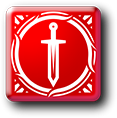
Success
Successful completion of the action. When used in an Attack, it deals the amount of Damage according to the Damage value indicated on the Card.
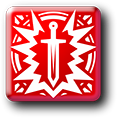
Critical Success.
Successful completion of the action. When used in an Attack, it means Success, which cannot be canceled by the Success on the Defense Dice.

Nothing.
A value that means a lack of success.
Defence Dice
They are used to determine the protection characteristics of a Miniature.

Success
Cancellation of one usual (non-Critical) Attack Dice.

Critical Success.
Cancellation of either one Successful Attack Dice. In addition, if a Critical Defense Cube cancels a normal (non-Critical) Melee Attack Dice, then the Defending Miniature can damage the attacker in terms of the damage value of its Melee Attack Action (if the attacker is within range of this Attack Action).

Nothing
A value that means a lack of success.
Agility Dice
They are used to determine the chance to evade danger or improve the final result of dice rolls due to the innate abilities of the Miniature

Success.
The ability to reroll one of the dice that were rolled with it. Several successful Dice can be used to reroll the same dice.

Nothing.
A value that means a lack of success.
Skill Dice
They are used to determine the chance to perform an action with special mastery, improving its result.
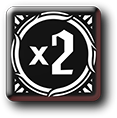
Success
The ability to double the value of one of the successful Attack Dice.

Nothing
A value that means a lack of success.
Card of Gods
"The world of Torn has always been a field of endless battle between the four entities of the Powers that are forever circling in a dance of combat, unable to overcome each other."
Speech by archaeologist G. Starn Eizky.
The battles in Torne's world are not only the confrontation of Expeditionary squads. The Gods of Torn often intrude in the fate of their followers, rewarding them for their faith
In the game interventions of the Gods is reflected in the form of special cards - Divine Intervention Cards (or Cards of Gods). Before the game the player will not only have to gather his Expedition Squad, but also make up his Deck of Cards of the Gods.
The list of God Cards available for collecting determines the Hero who will become the Leader of the Expedition. More about of collecting the Deck and the rules for playing the Cards of the Gods are described n the chapter "Cards of the Gods". Let's see what elements are on the card
1 - Name
The unique name of the God Card.
2 - Cost
The number of Tokens of Faith that a player must spend to play a card
3 - Rarety
The maximum number of doubles of the same card in the deck.
4 - Condition
The point in time when the card can be played.
5 - Text
Description of the effect that the God Card creates after successfully playing.
6 - Keywords
A set of words that can be referenced by the rules of the game.
Game Markers
During the game, players need to keep note important game parameters and mark elements for Scenary on the battlefield. Various Game Markers serve all of these purposes - we'll talk about them below
Tokens of Faith and Ether
During the game moments happen when the Miniatures show unusial zeal and success. These actions see by the Gods, who always look at their followers and reward them.
Each time a player rolls dices for Action and gains a Critical Success, he also gains 1 Faith Token
The Faith Token look like crystals of four colors - one for each Domain..
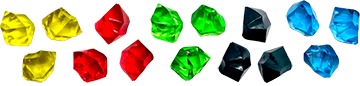
They are used for show actual reserves of the Ether.
Script Markers
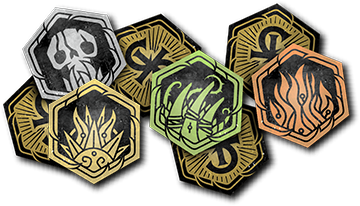
Many game Scenarios involve the using of special markers for key game elements: Prisoners, Artifacts, or Control Points. These markers are also used to indicate the devotion of the Ether Vortices.
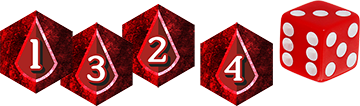
Wound Markers
During the game, Miniatures can get injured and lose their wounds. Players can use Wound Markers or regular dice to mark lost Wound.
Condition Markers
During the game, some situations can apply Condition to the Miniature. They are displayed with a special dice - each of its faces have one of the possible condition of the Miniature.
Burning Marker
Effect : The opponent rolls 2 Attack dice.  . For each success, the Miniature loses 1 wound. After the roll, remove the Burning Marker. If the result of the roll is a Critical Success,
  , then the Marker remains.

Slowed Marker
Effect : Remove the Slowed Marker. Infantry miniature: Until the end of Activation, it receives -2 Hexes for the Actions Move and Run. Large or Huge Miniature: before the end of Activation, it receives -1 Hexon for the Actions Move and Run

Poisoned Marker
Effect : The opponent rolls 1 Attack Dice If successful, the Miniature loses 1 wound.
Stunned Marker
Effect : Remove the Stunned Marke. Miniature loses 1 Time Marker  for Activation
Bleeding Marker
Effect : Miniature loses 1 Wound. Miniature with a Bleeding Marker can spend 2 Time Markers in its Activation to remove the Bleeding Marker.
Panic Marker
Effect : Remove the Panic Marker. The miniature loses one Time Marker after which it moves towards its Deployment Zone at the distance of its Move. It must bypass hexes with negative effects or possible threats When it reaches the border of the Deployment Zone, the miniature moves to the most distant Hexes. If the miniature has reached the most distant hexes of its Deployment Zone, then it stops.
Marker effects are triggered in "Step 4: Triggering Condition Markers".
Game Landscape
Different types of game Landscape are used for the game, which are located on the battlefield depending on the selected Scenary. The game has the following types of terrain: Volume Landscape and Flat Landscape.
Volume Landscape
Volume Landscape are objects on the battlefield that represent different kinds of world elements. They are tall and voluminous enough to allow explorers to take cover behind them from enemy attacks.
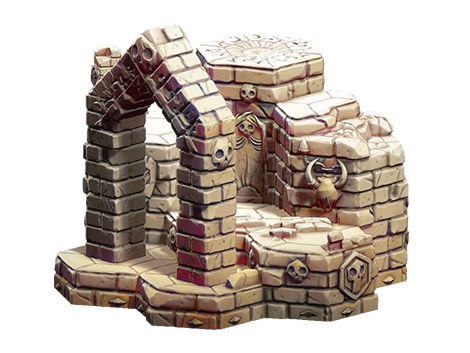
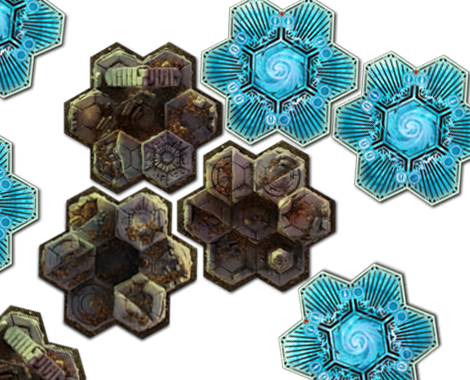
Miniature of Volume Landscape "Westorn Ruin".
Volume Landscape can be displayed on the battlefield with special flat tiles or with volume elements. By choosing to display using volume elements, players can use both official Miniatures of the Tornscape Landscape, as well as any suitable scale, the size of which is a multiple of a Hexon.
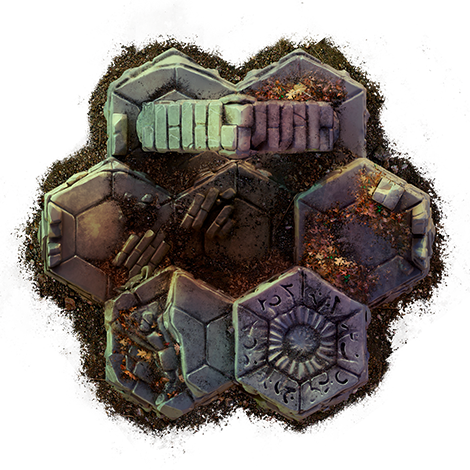
A flat tile of The Volume Landscape "Ruins Of Westorn".
Volume Landscape has the following rules:
It always takes 1 Hexon.
A miniature cannot takes Hexes with Volume Landscape.
A miniature cannot pass through Hexes occupied by a Volume Landscape (except those with the ability to pass through a Volume Landscape).
A miniature occupying a Hex adjacent to a Volume Landscape benefits from range attacks according to the rules described in the chapter "Miniature Visibility".
Dangerous Landscape
Objects on the battlefield that pose a threat to miniatures are considered a Dangerous Landscape. They are presents as tiles or are part of the surface of the battlefield. The miniature gets the effect of a Dangerous Landscape (no more than once per activation) if:
Started activation on the element. (Step 2 "Landscape Effects")
Ended activation on the element.
When enter to the element and leaves it during one activation (gets an effect at the end of the action).
Fiery Earth
Area of land with scorching lava or liquid flame.
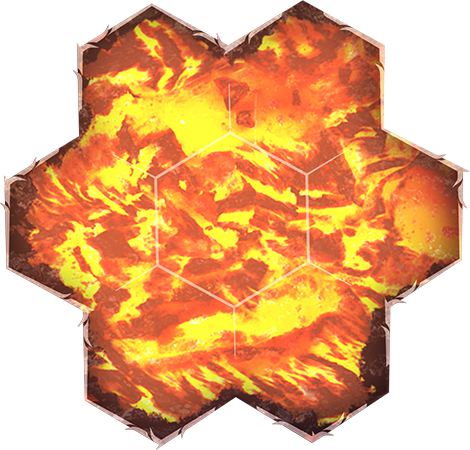
Effect - the miniature receives the Burning marker  and becomes the target of the Attack:

Ruinous Swamp
A swampy area soaked in flesh-eating ether poison.
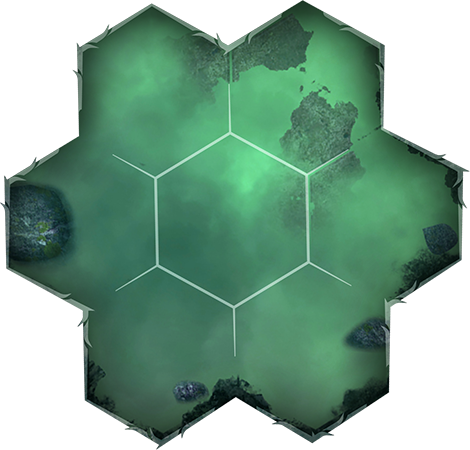
Effect - the miniature receives the Poisoned marker  and becomes the target of the Attack:

Landscape elements that are part of the surface of the battlefield ield cannot be destroyed by an effect or ability.
Ether Vortices
The most dangerous parts of the world, which are called Ether Centres, contain as many treasures of the past as dangers.
One of them is Ether Vortices, whirlpools of unstable energy.
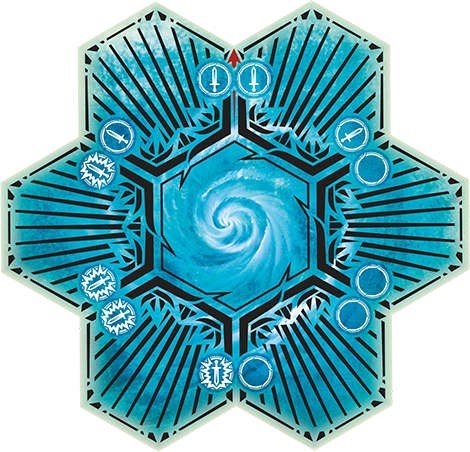
Ether Vortices have the following rules:
A miniature takes a Hex adjacent to the Ether Vortex benefits from range attacks according to the rules described in the chapter "Miniature Visibility".
A miniature exploring the Ether Vortex or passing through it receives the effects described in detail in the chapter "Ether Vortices".
Each Ether Vortex has a supply of Ether, the amount of which is described in the Scenary. When Vortex loses the last point of Ether, it is removed from the battlefield.
Ether Vortices move across the battlefield at the end of each turn according to the rules described in the chapter "Ether Vortices".
Cards of Ether Wonders
Deck of Cards of Ether Wonders is needed to interact with Ether Vortices
It's should always be near the battlefield so that both players can interact comfortably with it.
The interaction with the deck of Aether Wonders is described in detail in the chapter "Ether Vortices".
Summary
Volume Landscape - Ruins
• It is not allowed to pass through and complete the movement on the Landscape.
• Get Cover.
Fiery Earth or Ruinous Swamp
• Possible to pass through and complete the movement on the Landscape.
• When enter miniature receives a Condition Marker and an attack.
Ether Vortex
• Possible to pass through and complete the movement on the Landscape.
• When enter Miniature gains the effects of Ether Wonders Cards.
• Get Cover